

Manifesto
A Better AI for the World
A short book in nine chapters.
Contents
- Before you read
- 1Everything starts clumsy
- 2The law of more
- 3Bigger isn’t the only road
- 4Committed to more
- Table 1. Call for call, a business that bills by the token earns most on its biggest model
- 5The jobs are narrow
- 6Open weights are the soil
- Figure 1. From the frontier to one machine
- 7The oldest move in the book
- 8What we ask for
- 9The world at the right size
- Corrections
Draft v4.1 · 14 Nov 2026
© 2026 Nest Technology · São Paulo
Before you read
This is what we believe at Nest, why we believe it, and what we’re asking for. Every fact here has a source you can check. Where we give an opinion, we say so. We sell small, specialized AI models, so we have a stake in this argument. Please weigh everything that follows with that in mind, including the parts you agree with.

Chapter One
Everything starts clumsy
The first general-purpose electronic computer weighed 30 tons. ENIAC, unveiled in 1946, used 17,468 vacuum tubes, drew 150 kilowatts and managed about 5,000 additions a second. The first powered flight, in 1903, lasted twelve seconds. The first handheld cellphone went on sale in 1984 for $3,995, gave you thirty minutes of talk and took ten hours to charge. The first practical solar cell, in 1954, turned about 6% of sunlight into electricity.
None of these first versions was a mistake. They were first. A technology is almost never born in its best shape. It starts out big, expensive and in few hands, and then it gets smaller, cheaper and closer to the people who use it. Since 1976 the price of a solar module has fallen more than 99%.
AI is on the same road, and this time we can measure the trip. In 2022 the smallest model that scored above 60% on a standard knowledge test had 540 billion parameters. Two years later it had 3.8 billion, 142 times smaller. Over the same stretch, running a model as capable as GPT-3.5 got about 280 times cheaper.
Today’s giant general models are a real achievement. We think they are also AI’s ENIAC: the first shape, not the final one.

Chapter Two
The law of more
In January 2020, a team of researchers published a result that would shape a decade. Language models improved smoothly and predictably as they got more parameters, more data and more compute. Next to sheer scale, the details of the design mattered little, and the advice was to spend extra compute mainly on bigger models: “Big models may be more important than big data.”
Put simply: more compute in, more capability out. For years the two climbed together, smoothly enough to plan on.
It was good science, and it also became a business plan. In fact the bet came first. Six months before the paper, the lab where it was written had taken a billion-dollar investment from a cloud giant. A year after the paper, four of its authors helped found a second lab. The law of more became the operating model of the most valuable AI companies in history.

The first correction arrived in 2022. DeepMind trained more than 400 models and found that the large models of the day were “significantly undertrained”. On the same compute budget, its 70-billion-parameter model, trained on four times as much data, beat a 280-billion-parameter one. The first footnote of the scaling era was a smaller model winning.
The correction was about how to spend compute, not how much. The money kept its course. The first lab’s finance chief later showed its computing power growing from about 0.2 gigawatts in 2023 to about 1.9 in 2025, with its revenue climbing alongside. In September and October 2025 it announced chip deals for at least 26 gigawatts, most of them preliminary, and in November its head wrote of “commitments of about $1.4 trillion over the next 8 years”.

Chapter Three
Bigger isn’t the only road
Scale works. For broad, general ability, more compute has paid off; over the past decade it did more for progress than clever algorithms. New capability still arrives first where the compute is. But a model doesn’t have to be bigger to be better at a job. It needs the right data for that job, and a design that fits it.
Our Benchmarks page collects published tests of exactly this, and the recent ones are clear. In early 2026, a university researcher fine-tuned a 125-million-parameter text classifier, a design made to sort text rather than write it. It sorted news by topic more accurately than a leading frontier model, at an estimated $10 per million requests against about $440. In September 2026, a research team at an insurer tuned an open vision model of about 8 billion parameters on 2,998 computer-generated checks. On 750 new ones it read every field right 88.9% of the time; the best commercial system they tested managed 45.4%.
Smaller, and better at the job
Four recent published tests. In each, a small model trained for one job beat the strongest general model the testers ran.
Small model, trained for the jobStrongest general model the testers ran
Sort news by topic macro F1, 0–100
Trained for the job: RoBERTa-base, fine-tuned · 125M
General model: Claude Sonnet 4.5, zero-shot
Read four fields off a check F1, 0–1
Trained for the job: Qwen2.5-VL-7B, fine-tuned · 8.3B with its vision encoder
General model: GPT-5, zero-shot
Label court decisions, 260 tasks accuracy
Trained for the job: Lawma 8B, fine-tuned · 8B
General model: Claude 3.7 Sonnet, zero-shot
Answer questions from an email inbox answered correctly
Trained for the job: ART·E, trained with RL · 14B
General model: o3
Two more tests point the same way. A model trained on court records beat the best commercial model its authors tested at labeling court decisions across 260 legal research tasks, and an email-research agent trained by trial and error beat a top reasoning model at answering questions from an inbox. It isn’t magic, and it doesn’t hold everywhere: in the news study the general model was more accurate on movie reviews, and in the check study a smaller tuned model stumbled on checks of a kind it had never seen. Size buys breadth. Fit wins the job.

Chapter Four
Committed to more
If small models trained for one job do it better, why don’t the largest labs build them? Partly, they do. They all sell small, cheap models, and a few publish open ones, some trained for one job, such as screening content for safety (one of those is on our Benchmarks page, beating a frontier model). But the small models they sell are general, and the first lab from chapter 2 is winding down its service for tuning them. The second lab from chapter 2 says its business customers tend to choose its most capable models.
We think the larger reason is the incentive. A lab is paid by the token, priced by the model you pick, and call for call a frontier model bills about 30 to 140 times what a small open one does (Table 1). Researchers at NVIDIA, the chipmaker, estimate that the big model also takes 10 to 30 times the computing to serve. A lab committed to its compute earns far more from it when each call runs on its biggest models.
Those commitments are large. The second lab’s filing to list its shares shows about $895 billion of them running to 2045, nearly all compute and infrastructure, almost $70 billion due within a year and generally payable “regardless of our revenue or utilization”. They are contracts, not debt, but the industry is borrowing too: so far in 2026, five of the largest US tech companies sold over $370 billion of bonds, about a fifth of all US investment-grade issuance, much of it to fund AI, and at the end of 2025 they had nearly $1 trillion of leases ahead of them, mostly for data centers. One consultancy reckons that meeting AI’s demand for compute will take $6 trillion of revenue a year by 2031.
The lab’s own figures show why the price of each call matters. To the end of 2030 its commitments average about $105 billion a year, and its sales run at about $68 billion a year. If the narrow share of agent calls, about 60%, ran on small models priced 30 times lower, the same calls would bring in about $28 billion.
What pays the bill
One lab’s compute bills, a year on average to 2030, against its sales at today’s prices and the same calls priced like small models.
The billSales at big-model pricesSales at small-model prices
The bill: compute commitments, a year on average to the end of 2030
US$105.3B
447.5 ÷ 4.25 years
Today’s sales, at the latest quarter’s pace
US$67.8B
Calls needed to meet the bill: 1.6× as many as today · 16.96 × 4
The same calls, with the narrow 60% on small models priced 30 times lower
US$28.5B
Calls needed to meet the bill: 3.7× as many as today · 67.8 × 40% + 67.8 × 60% ÷ 30
The same calls, all on small models priced 30 times lower
US$2.26B
Calls needed to meet the bill: 47× as many as today · 67.8 ÷ 30
At big-model prices the bill needs about 1.6 times today’s calls, and the lab’s quarterly sales grew about twelvefold in the year to September. At small-model prices it needs nearly four times today’s calls with only the narrow work moved, and 47 times with all of it. We think that is why the math closes only one way: with narrow work on big models. So far the lab has had less compute than demand, and cheaper calls do bring more calls. But the bills run to 2045, and every narrow call priced like a small model gives up about 97% of its revenue. That is an incentive, not a conspiracy.
A small model fitted to one job costs a fraction per call, and the filing counts customers moving to cheaper or open-weight models among its risks. We think narrow work belongs on small models fitted to it. The big labs’ incentives point the other way. Ours point this way, as we said up front, and NVIDIA, whose research we cite, has its own.
Table 1
Call for call, a business that bills by the token earns most on its biggest model
One agent doing one narrow job. Each call reads 3,000 tokens and writes 400. List prices on 30 Sep 2026, with no caching, batch or negotiated discounts.
| Where the calls run | Per call | 10M calls a month | 100M calls a month |
|---|---|---|---|
| The largest frontier models ($10 in / $50 out per million tokens) | $0.050 | $500,000 | $5,000,000 |
| A mid-price frontier model ($4 / $20) | $0.020 | $200,000 | $2,000,000 |
| A frontier lab’s own small models ($0.10 / $0.50 to $1 / $5) | $0.0005–0.005 | $5,000–50,000 | $50,000–500,000 |
| A small open model, billed per token ($0.10 / $0.15) | $0.00036 | $3,600 | $36,000 |
| A small open specialist on rented GPUs (2 at 10M calls, 14 at 100M) | $0.0004–0.0007 | $5,100–6,600 | $36,000–46,000 |
Show the arithmeticHide the arithmetic
What the frontier lab bills for this agent, on the mid-price model at 10M calls a month (the lab’s figures scale by 10 at 100M). On the open side, the low end is a small model billed per token; the high end is a tuned specialist on two rented GPUs:
| If... | The lab bills | The company pays in total |
|---|---|---|
| every call stays on the frontier model | $200,000 | $200,000 |
| 60% of calls, the narrow ones, move to a small open model | $80,000 (−60%) | $82,200–86,600 |
| ...and the remaining calls step down to a cheaper closed tier ($2 / $10) | $40,000 (−80%) | $42,200–46,600 |
| the same 60% move to the lab’s own small models instead | $83,000–110,000 (−45% to −59%) | $83,000–110,000 |
Note. Whoever serves the small calls, the lab bills less for the same agent, and almost all of the difference stays with the company that uses AI: the open side earns about $2,000–7,000 of it, so the company keeps about 94–98% of the $120,000 the lab stops billing. The 60% is one research team’s estimate for one open-source agent framework; its three estimates run from 40% to 70%. Cheaper calls also bring more calls, and total spending on AI may keep growing. We hope it does. Our claim is narrower: call for call, a business that bills by the token earns most on its biggest model.

Chapter Five
The jobs are narrow
Look at the AI agents a CTO already knows, and you find one job per agent. Abridge listens to a doctor’s visit and drafts the clinical note for the doctor to review and sign; it is live at more than 300 health systems. Cursor’s Tab does one thing, predict a programmer’s next edit; by September 2025 it was handling more than 400 million requests a day. Harvey, used by 80% of the 100 highest-grossing US law firms, trains separate models for single legal tasks. The one that answers from what a firm already knows is built on an open model of 27 billion parameters and, Harvey says, keeps pace with leading frontier models at a tenth of the cost per query.
Even agents that look broad are built from narrow parts. Fin’s customer-service agent, which the company says resolves more than 2 million conversations a week, runs on nine purpose-built models, one for each step, built on open-weight models; the one that decides when a person should take over is a compact text classifier. Sierra and Decagon, two of the best-known makers of support agents, train their own models for single functions, such as telling when a caller is another AI; at Decagon those models carry over 80% of model traffic.
The NVIDIA researchers from chapter 4 find the same shape. Most agent subtasks, they write, are “repetitive, scoped, and non-conversational”, and for many of them small models are capable enough, better suited and cheaper.
Not every part is small yet. Harvey’s main legal model is built on a large open one, Abridge pairs its own models with frontier ones, and others in the field run the same narrow job on a frontier model alone. The job is narrow either way, and a narrow job can be measured.
You wouldn’t hire a polymath to stamp invoices. You’d train someone for the job, measure them on the job and keep whoever does it best. That’s what we do for agents. We take a small open model, specialize it on the real traffic of one task, and test it side by side against the frontier. When it doesn’t measure up, it doesn’t ship.

Chapter Six
Open weights are the soil
Everything we build grows from open-weight models, published so that anyone can download, inspect, run and adapt them. You can’t specialize a model you aren’t allowed to hold. Open weights are to specialized AI what open-source software was to the internet: shared ground that thousands of builders stand on. A software giant’s chief executive once called Linux “a cancer” (he meant its license). Linux now runs all of the world’s 500 fastest supercomputers.
The ground is rich, and getting richer. Each frontier tier from GPT-4 to late 2025 reached an open model small enough for one high-end graphics card within 9 to 18 months, and the wait has roughly halved (Figure 1). Builders use it: on one AI gateway, open models carried 56% of tokens in August 2026, but only 14% of the money.
In one enterprise survey, open models’ estimated share of LLM API spending fell from 19% in 2024 to 11% in 2025. We think that’s the real gap: the capability is open, but someone still has to fit it to one task, measure it, serve it and answer for it. That’s our work.
Open weights are also where control lives. A model you host yourself can’t be changed, repriced or switched off by someone else’s decision, and your data doesn’t have to leave the building.
Control matters most under attack. By one security firm’s count, the average organization faced about 2,800 cyberattacks a week in September 2026, up 48% in a year. Microsoft’s latest yearly report found that a flaw spotted in the wild now becomes a working attack in well under a day at the median, that state-backed groups use AI agents to help run intrusions, and that for now attackers are gaining the advantage first.
Picture attackers turning an uncensored copy of a strong open model on your company, from their own machines. Researchers stripped a model’s safeguards in 2023 with one graphics card and under $200, and Google has reported an espionage group suspected of running an open model on servers it had broken into, beyond any provider’s monitoring. Now picture the defense on a closed model. Its rules rightly forbid probing systems without the owner’s permission, and its safeguards can block legitimate work too: in one study, models refused 43.8% of student defenders’ requests to harden systems. Some labs vet defenders for fuller access, and one first released its most capable model only to partners. That is permission, granted case by case. The attacker never asks.
The international AI safety report names both sides: safeguards that block cyber requests can hamper defenders, and open models let attackers work offline. We think the only defense at the same level is a capable open model that a company runs on its own machines, under its own rules, against its own systems.
Open weights carry real risks. The same safeguards can be stripped by anyone, and a release can’t be recalled. We take that seriously, and chapter 8 says what we would do about it. But a world where only a few companies may hold capable models is not a safer world, just a smaller one.
Figure 1
From the frontier to one machine
New capability arrives first where the compute is, at the few labs that can afford the largest training runs. Months later an open model of about 30 billion parameters reaches the same tier on one machine, trained, by our rough pre-training estimate, on a shrinking share of the frontier’s compute, from about the same for the GPT-3 tier to a small fraction today. Since GPT-4 the wait has roughly halved, from about 18 months to about 9. The dashed row is a projection, not data.
What is measured. For each tier, the months from the first frontier model to reach it until the earliest open-weight model of 27–34 billion parameters that matched it on published benchmarks and runs, compressed to 4 bits, on one high-end consumer graphics card. One rule for every row: the open model is ahead on most of the benchmarks both makers published and no more than about a point behind on any other (row 2, a near-tie on one leaderboard, is marked as such).
Read it with care
- Benchmarks flatter small models. Most scores here are reported by the models’ makers. Epoch AI notes that small open models are more likely to be optimized for benchmarks, so the real-world gap may be longer; its own benchmark analysis finds a similar 6 to 12 months for models that fit one gaming GPU. Against the best open model of any size, rather than one machine, the gap is only 3 to 4 months.
- Part of the followers’ speed comes from larger models. Open labs distill their small models from their own flagships, which, their reports say, cuts the compute needed.
- Separately, frontier labs have accused several China-based open-weight labs of distilling their models’ outputs at scale; one lab’s September 2026 report names seven. That report says that operators affiliated with the maker of four of the six open models charted here used its reasoning transcripts to help train that maker’s 3.5, 3.6 and 3.7 generations, which include one model charted here (row 5). These are claims by an interested party that we can’t check, and we found no public response as of 30 Sep 2026. If the claim is true, row 5’s lag and that tier’s compute ratio partly reflect frontier compute.
- Tiers are matched on text, reasoning and coding benchmarks. Some frontier models also do things, such as live voice, that the open markers don’t.
The open labs
- Reach. One open family (Qwen) has 151,448 derivative models on Hugging Face and about 2 billion downloads in 2026 to mid-August.
- Use. Open-weight models handled about a third of the tokens on one large model marketplace by late 2025, and 56% of August 2026’s tokens on one AI gateway, but only 14% of its spend.
- Price. An open 27B model costs $0.30 in / $2.00 out per million tokens on a public API; the largest frontier models cost $10 / $50.
- The counterpoint. In one enterprise survey, open models’ estimated share of LLM API spending fell from 19% (2024) to 11% (2025).

Chapter Seven
The oldest move in the book
When a new technology threatens a toll booth, the toll-keepers rarely say “our revenue”. They say safety, quality, order. Some of them mean it. The pattern repeats anyway. Each story below has two halves: the gate, and what happened when it opened.
The press. In 1662 an English law set out who could print. No new master printers were to be admitted until their number fell to twenty, most could keep no more than two presses, and every book needed a license before it went to press. Even a carpenter had to tell the printers’ guild before building a press. When better editions of Cicero arrived from Holland, the guild seized them and charged a fee on every copy. In 1695 the House of Commons refused to renew the law: it had never achieved its own purpose, and offenders could be tried under the ordinary law anyway. John Locke had argued that letting anyone print the classics was “the way to have them the cheaper and the better”.
England stopped asking printers for permission first and held them answerable afterwards. That is the rule we ask for models.
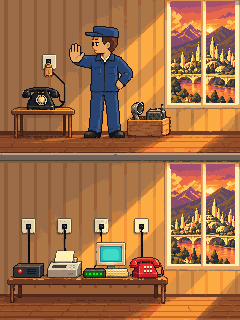
The phone plug. For decades the phone monopoly banned any device “not furnished by the Telephone Company”, even a cup that clipped onto the mouthpiece for privacy; customers, it said, could cup a hand instead. A court sided with the cup’s maker in 1956. In 1968, after a fight over a radio cradle called the Carterfone, the regulator struck the blanket ban down. The monopoly then required its own connecting box on every outside device, until rules of 1975 and 1976, upheld in 1977, let anyone plug in equipment registered to a public standard. A mass market for answering machines, fax machines and modems followed, and the modem carried the internet into homes.
The phone company said only its own equipment was safe on its network. A harm test and a standard plug let anyone build for it. Open weights are that plug for AI.

The video recorder. In 1976 film studios sued the maker of a home video recorder, and in 1981 an appeals court held it liable. At a 1982 hearing, Hollywood’s chief lobbyist warned Congress of an avalanche of recorders and said the machine was to filmmakers and the public what “the Boston strangler is to the woman home alone”. He backed a fee on every recorder and every blank tape. In 1984 the Supreme Court, by five votes to four, protected tools capable of substantial lawful uses. In 1980 about 1 in 100 American homes with a TV had a recorder; by 1990 more than two in three did, and Americans came to spend far more on home video than at the box office.
The studios wanted a copying machine stopped or taxed because some people would misuse it. The Court protected a tool with substantial lawful uses: the dual-use argument for open weights.
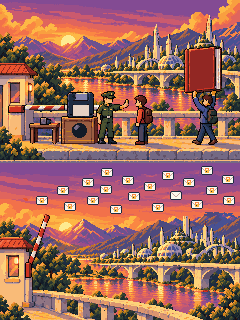
The code. Until 1996, strong encryption software sat on the US list of munitions, and exporting it needed an arms license. In 1994 the government ruled that a book printing encryption code could leave the country, but that a floppy disk holding the same code was controlled like a weapon. Browsers sold abroad were held to weak keys by law; in 1995 a researcher with about 120 workstations broke one session’s key in eight days. The code spread anyway. In January 2000 the rules opened: encryption could go to almost any non-government user abroad, and open-source code could be posted online after an email notice. In 2015, twenty years after that broken key, the weakened export mode was still a hole attackers could use, and today nearly every page load in Chrome is encrypted.
Code anyone could print was treated as a weapon; the code leaked past the rule, left weak spots behind, and the rule was lifted. Model weights are copyable information too.
Today’s version is quieter. No one needs to ban open models; we think making them expensive, suspect or foreign is enough. The proposals are on record: licenses above a certain scale, allied data centers barred from Chinese-made equipment and models that create security risks (later recast as export rules), and certifications for the most capable models that critics say open weights can’t keep. We don’t doubt anyone’s sincerity, but we think such rules are easiest to meet for the firms that propose them.
In all four stories the gate came down and openness won. A press, a plug, a recorder, a page of code: each was a tool anyone could copy or build on. So are open weights.

Chapter Eight
What we ask for
In 2023, the head of one of the largest labs asked the US Senate for an agency to license AI work above a certain scale. In 2025, asked about a heavy-handed, EU-style prior-approval regime, he said it “would be disastrous”. We agree with the second answer. We aren’t against rules. We’re for the kinds that have worked.
Regulate harm and use, not weights. Hold people answerable for what they do with a model, as England came to hold printers answerable for what they printed, instead of licensing the model in advance. Laws aimed straight at a harm work no matter which model was used, like the US law against publishing non-consensual intimate images.
Test by capability, not by openness or origin. For the rare model with truly dangerous capabilities, open or closed, testing before release makes sense. A small model that reads invoices is not that model. Even a frontier lab known for its focus on safety calls open models without dangerous capabilities “a public good”. Test the model, not the passport.
Prefer evidence and transparency to licenses. In 2024, the US agency that studied open weights recommended monitoring the risks, not restricting the models. Europe exempts open-source models from some duties below its top risk tier.
Keep the field open. Any pact among a few labs to set the pace of AI shouldn’t be written without the rest of us.
Hold deployers accountable, starting with us. We answer for every model we ship, and we will publish how we test them.

Chapter Nine
The world at the right size
Picture this valley a few decades on. Most of the intelligence in it is small and close at hand: in the clinic, the farm office, the town hall, the phone in your pocket. Each model does one job and answers for it, and it costs so little in money and power that nobody thinks about it. That’s how we treat GPS and Wi-Fi today, two commons that exist because someone chose to open them.
In that world, machines take on the repetitive work. They sort, read, check and deliver, and robots carry what needs carrying. People spend their days on work they choose. Technology and human life fit together, not because someone promised it, but because people own and understand their tools.
We won’t pretend AI ends hunger or inequality on its own; no technology has. But cheap, open, useful tools in many hands have lifted people before: the printed page, the phone line, and the open network that now reaches about 6 billion people and still misses 2.2 billion. Solar modules got about 20% cheaper with every doubling of the world’s capacity. We think intelligence could follow a curve like that, if it stays open.
Every task has a size, and our work is to make intelligence fit it. Nothing over, nothing missing. AI that is open to everyone, runs on a fraction of the power and does real work.
The world, at the right size.
Afterword
Corrections
If we got a fact wrong, tell us at guilherme@nest.technology. We fix errors on this page and date every change. Last updated: 14 Nov 2026.
Corrected on 7 Nov 2026. Chapter 7 (chapter 6 in the first edition): the phone monopoly’s “absolute control”, which we couldn’t trace to a source, is now the words of its own tariff; the claim that Americans spent “2.6 times more on home video than at the box office”, which we couldn’t confirm, now says “far more”, from Census spending per person, and we added the share of homes with a video recorder; and the closing line “incumbents often did better than they feared”, true in only two of the four stories, now says only what all four show. Chapter 4, note 4 (chapter 3, note 4, in the first edition): the NVIDIA paper’s comparison with a US$5.6 billion API market was dropped in its second version, not its third, and its US$57 billion figure is the value of data-center deals, not spending on inference.
Also changed on 7 Nov 2026. A new chapter 4, on why the largest labs keep building big; chapter 2 told in two spreads, without its summary chart; chapter 3 rebuilt around tests from our Benchmarks page; chapter 5’s examples replaced with six named companies, each using AI for one narrow job; the stories of chapter 7 told at more length; two press-reported figures for one lab’s compute plans taken out, because we couldn’t re-check them; and the afterword on our incentives taken out, since “Before you read” and chapter 4 now cover it.
Also changed on 14 Nov 2026. Chapter 4 now argues from incentives: a short worked figure sets one lab’s yearly compute bills against its sales at today’s prices and at small-model prices, it replaces the chart of that lab’s commitments to 2045, and the chapter adds dated figures on the industry’s borrowing for data centers. Chapter 5’s examples are now the agent companies a technology lead is most likely to know, each tied to the narrow job it does. Chapter 6 adds the case for defending at the same level as attackers who run open models without safeguards, with dated sources on today’s attacks and on the limits closed models put on security work.
The world, at the right size.
Thanks for reading. If this is the world you want to build, let’s talk.